
What Huons' FDA Warning Letter Reveals About Today's CGMP Enforcement

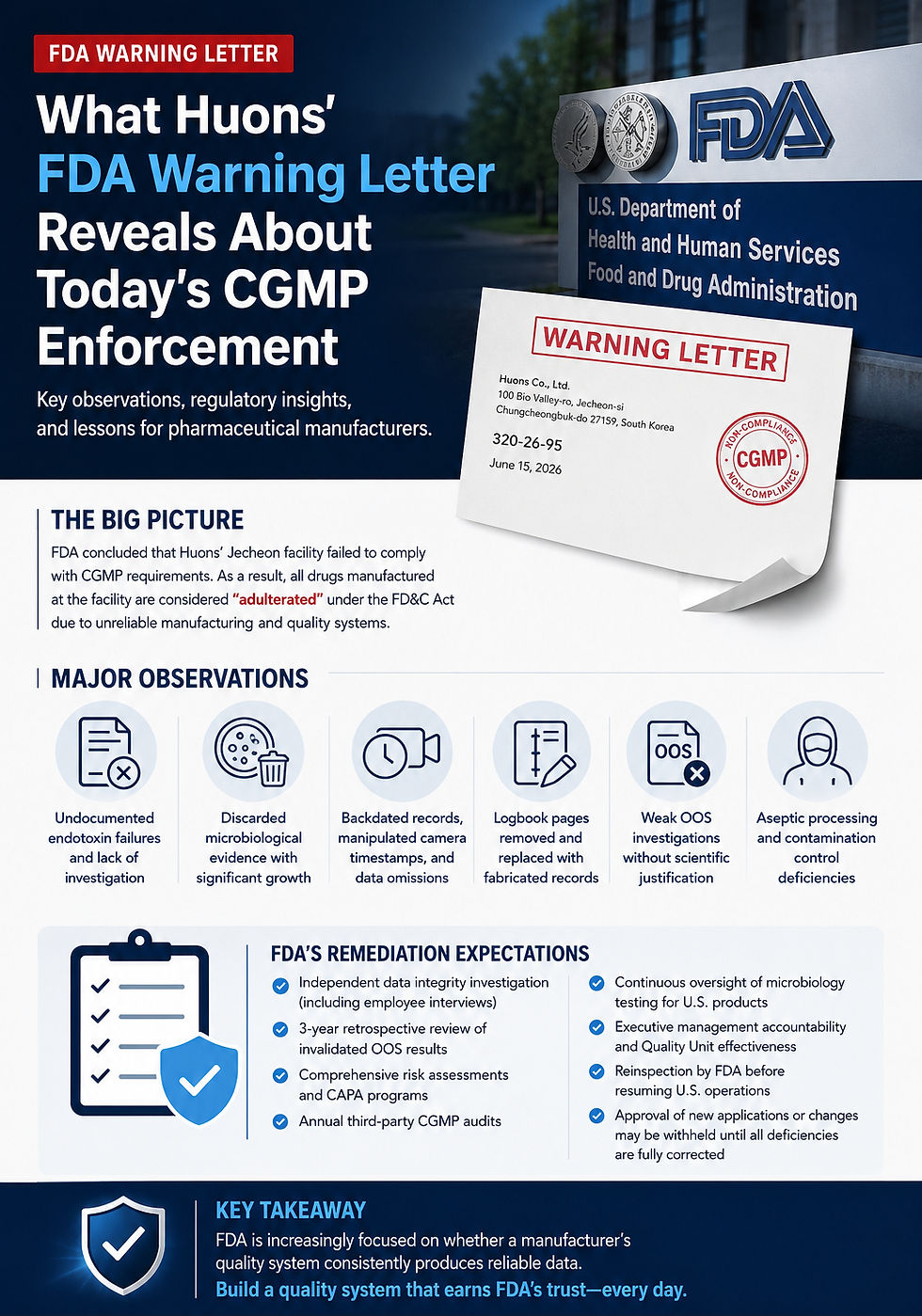
In June 2026, the U.S. Food and Drug Administration (FDA) issued a Warning Letter to Huons Co., Ltd. following an inspection of its sterile injectable manufacturing facility in Jecheon, South Korea.
While Warning Letters are not uncommon in the pharmaceutical industry, this case stands out because it goes far beyond isolated documentation issues. The FDA concluded that the company's manufacturing systems, laboratory controls, and quality oversight failed to comply with Current Good Manufacturing Practice (CGMP) requirements, ultimately classifying products manufactured at the facility as adulterated under the Federal Food, Drug, and Cosmetic Act—not because contamination was confirmed, but because the quality systems could no longer be relied upon.
The Core Issue Was Trust in the Quality System
The Warning Letter highlights one message repeatedly:
FDA no longer trusted the data generated by the facility.
Among the inspection findings were:
Endotoxin test failures that were not documented or investigated.
Significant microbial growth that was discarded instead of being reported.
Manipulation of laboratory records through backdating and altered camera timestamps.
Logbook pages removed and replaced with fabricated records.
Nearly 1,900 uncontrolled blank CGMP forms found within the laboratory.
Out-of-Specification (OOS) investigations that lacked scientific justification.
Weak management oversight and inadequate Quality Unit authority.
These observations collectively raised serious concerns about data integrity, one of FDA's highest enforcement priorities.
Data Integrity Is More Than Documentation
Many companies still think of data integrity as a documentation issue.
FDA does not.
When inspection records cannot be trusted, FDA questions every quality decision that relied upon those records.
This includes:
Product release decisions
Sterility assurance
Environmental monitoring
Laboratory testing
Stability programs
Batch disposition
Once confidence in data is lost, FDA must assume that the entire quality system may be compromised.
That is exactly what occurred in this Warning Letter.
Sterile Manufacturing Faces Even Greater Scrutiny
Because the facility manufactures sterile injectable products, FDA also cited significant aseptic processing deficiencies, including:
Inadequate airflow demonstrated during smoke studies.
Operators obstructing first air in critical ISO 5 areas.
Weak Restricted Access Barrier System (RABS) practices.
Insufficient glove monitoring and disinfection procedures.
Poor contamination control strategies.
For sterile products, FDA expects manufacturers to demonstrate—not assume—that contamination risks are effectively controlled.
Why FDA Requested Independent Third-Party Oversight
Another notable aspect of this Warning Letter is FDA's remediation expectations.
Rather than requesting procedural updates alone, FDA required:
Independent data integrity investigations
Interviews with current and former employees
Three-year retrospective review of invalidated OOS results
Comprehensive risk assessments
Long-term CAPA programs
Annual third-party CGMP audits
Continuous oversight of microbiology testing for U.S. products
Executive management accountability
This reflects FDA's increasing expectation that systemic quality failures require systemic remediation.
Business Impact Goes Beyond Compliance
The regulatory consequences extend well beyond the inspection itself.
FDA acknowledged Huons' suspension of U.S. production, the company's voluntary recall of U.S. products, and placement on Import Alert 66-40. The agency also stated that it may withhold approval of new applications or manufacturing changes until all deficiencies are fully corrected and verified through reinspection.
For manufacturers, this demonstrates that a Warning Letter can directly affect:
U.S. market access
Regulatory approvals
Customer confidence
Supply continuity
Global business reputation
FDA Warning Letter: Key Takeaway
The Huons Warning Letter illustrates an important regulatory trend.
FDA is increasingly focused on whether a manufacturer's quality system consistently produces reliable data—not simply whether individual products meet specifications.
When data integrity, quality oversight, and aseptic controls fail together, FDA treats the issue as a systemic compliance risk rather than a collection of isolated observations.
For pharmaceutical manufacturers supplying the U.S. market, the lesson is clear:
CGMP compliance is ultimately built on trustworthy data, effective quality systems, and strong management oversight.


